Orchestrating Chaos: The Meditative Image
The Creative Process
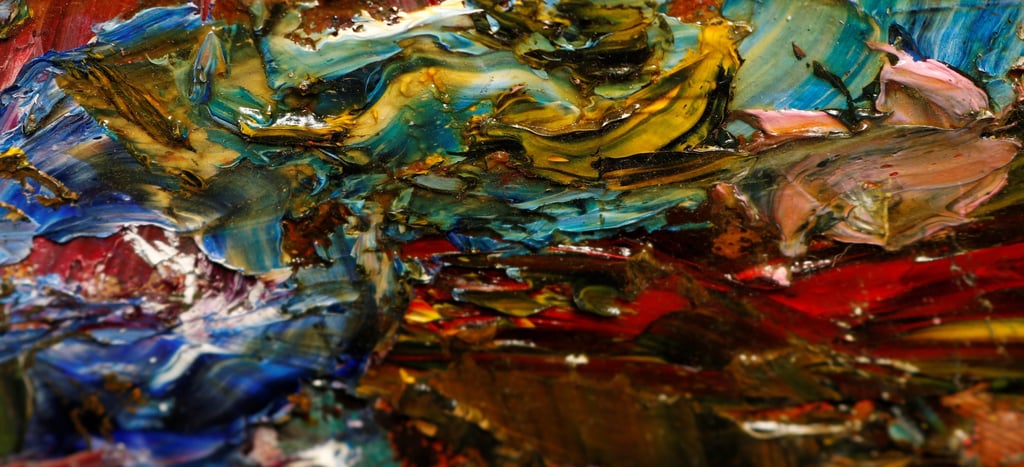
My creative process begins with experience rather than representation. The substance of the work is not simply the physical material of the painting but a vehicle for perception—a means of encountering new ways of seeing. Through the act of making, the work becomes a place where consciousness, intuition, and imagination meet.
Rather than relying on a fixed symbolic language or a universal dictionary of meaning, I am interested in personal visual symbolism. Psychological perspectives suggest that an image reveals more through an individual's own associations than through predetermined interpretations. My work embraces this idea by functioning as an intimate mirror for consciousness, inviting the viewer to discover meanings that emerge from within themselves rather than those imposed from outside.
The abstract and subtly surreal nature of the paintings creates an ambiguous visual space that resists definition. This openness allows projection and imagination to occur, giving the unconscious an opportunity to meet the image halfway. It is within this uncertainty that illusions, visions, sensations, and unexpected associations begin to materialise. The unconscious communicates through images, symbols, and feelings, and the work seeks to provide a receptive space for that silent dialogue.
I do not approach abstraction simply as a style or pictorial format. Instead, I understand it as a substance—a field of movement, vision, form, and experience. The paintings are not intended to describe an object but to evoke a state of perception in which awareness itself becomes the subject.
The work evolves through an ongoing dialogue between two opposing creative forces. One is spontaneous, immediate, and rooted in the present moment; the other is grounded in conventional principles of composition and planned design. These contrasting impulses rarely agree, yet it is precisely within their tension that the work comes alive. This dynamic resembles the behaviour of chaos, where constant sensitivity to change generates unexpected order. The painting becomes the product of this "perfect storm"—an evolving process in which the artwork gradually discovers its own form.
Each painting is the culmination of countless experiences, habits, and pathways embedded within the subconscious. It is not merely constructed but allowed to emerge through an accumulation of perception, intuition, and material response. In this sense, the artwork is less an illustration of an idea than a crystallisation of lived experience.
I know there is something within the finished work that cannot be fully explained in words. It is embedded in the painting itself—that intangible quality which gives the work its deepest value. It is not immediately visible but becomes accessible when the viewer enters a contemplative or meditative state of looking. In that encounter, the artwork communicates what cannot be spoken: the ineffable dimension of experience.
The paintings offer a place where illusions, visions, hallucinations, memories, and images are free to emerge within the viewer's perception. They do not instruct or define; instead, they create conditions in which consciousness can recognise itself through visual experience.
Meditative awareness lies at the heart of this process. It is not driven by will or intention but by attentiveness to continual change. Through this awareness, moments of transcendence arise naturally. My role as the artist is to crystallise those fleeting subjective experiences into material form. The artwork becomes a vessel that holds the transcendent within the physical—a vehicle in which illusion, perception, and consciousness converge, allowing the invisible dimensions of experience to become momentarily visible.